“Something
sophisticated reacts with something much more unpredictable”
“The idea of
using a syringe was a studio accident” art critic remarked one day he’ll use a
syringe and thought that was a good idea
“perfect
lines almost of liquid fluid paint”
uses famous
paintings eg The Ambassadors as colour reference. Tin tin, simposons. Sometimes
uses photoshop
“using a
painting or a cartoon is like a readymade for me”
“paintings
themselves are about dripping and dripping colour, which is also kind of a
readymade” duchampian aspect to them
long process,
choosing colour and sequence, actually making the piece also a long process
“whole
process done in one go, and its quite a performance”
“there is a
very performative aspect to the way these works are made”
“something
interesting about the paradoxical nature of it where some things that shouldn’t
particularly work together, come together in a visual way and really just connect”
https://vimeo.com/75990442 Ian
Davenport “Colorfall” at Paul Kasmin Gallery, 12 September - 26 October, 2013
Ian Davenport, theEYE - interview based artist profile
Worked with a company specialising in architectureal panels - something industrial about his work
Sees himself as a sculptur who makes paintings.
At the start wasn't interested in col0our, but interested in materials. As he developed as an artists, became more interested
Mastered how to control the liquid, so was able to concentrate on the colour and pattern
Paint is viscous and thick - manufacture own paint

Uses a syringe to pour the paint carefully and precisely from the top

Handmade qualities to paintings
Wanted to explore options and find the best way to develop as an artist
At university, was surrounded by paint pots in the studio, latched onto them as a subject, after period of weeks became more interested in the way the paint was dripping down the side of the cans

Tried to find unconventinal ways of painting - electric fan came from an open window that accidentally blew paint across a piece - complete accident
How long does it take to maker a painting? wanted to question this - fan paintings took a matter of seconds - is that long enough to make an interesting piece of art?
 |
| Electric Fan Paintings |
Why do you use a painting brush to make a painting? What happens if you use a pin?
Had no money - what is the least amount of paint I can use to make a painting?
 |
| Satin Black on White from the Bottom to the Top |
Dip paintings - something about working small felt right - compares to dipping a biscuit in a tea

Black paimtings - poured black gloss over matt black paint on the floor in cirles then lifted up and let it run to form these shapes. Simple, repeated. To see the painting you have to walk up and down them, a sculptural way of viewing art

Used board - subject kept flat, paint didn't dip in the middle. Gravity will pull the paint into the arch shape
Simple works intriguing because can be very complex at the same time. Lots of different decisions being made


Studio would be very messy and the paintings are almost immaculate - peculiar tensions
explore opposites, dialogue between paradoxes and contradictions

Dialogue with gravity, create tension,

Wasn't very good with colour, thought he'd give it a go. Exciting to see lots of colours in the studio. Didn't know what he was doing but just felt fun.
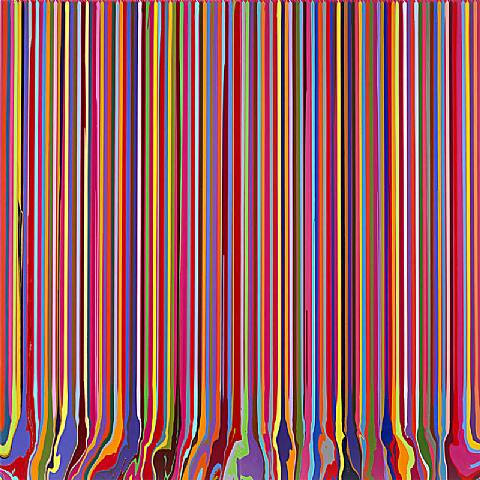
Commissions: sometimes have to move back to go forward. Used to be scared of repeating things he had already done
Studio filled with colour charts

Pieces are never planned out, sense of whats going to happen - informed from past pieces.
Uses a computer to create studies - easy to recreate and edit - nothing like the impact of the real thing though
Dialogue between control and chance - important elements. balance try and explore. surface tension
Pooling that happened at the bottom, indicates how the painting was made, surface qualities, rich add-on, didn't want to have to cover the painting in anyway to protect it from scuffs from bags and trolleys, this ridge with pooling allowed him to protect work and give idea of the process involved

Often show in a perfect white cube, Southwark street was very un precious, scale is huge, longer than sistine chapel - liked the amition of it. Feels natural to work on a large scale

Having an aspect that is very immediate, drawn into the work, seduced by the surface, tactility, colours. In a world where we are bombarded with images good to have some immediate
Hard to summarise why artists make art, exploring the world in visual terms, language feels comfortable with, answer questions couldn't do in another format
Lots of complexities with making art. Don't like to be tied down. Artists get frustrated with title eg Pop Art, Minimalism etc
Might say something that 2 weeks later disagrees with, contradict himself - like that - challenges self, challenge ideas, challenge own ideas
Ian Davenport, Martin Filler
'the unifying quality that underlies all of Davenport's varied output is a deep and abiding love of paint as his essential material' page 12
"preternatural understanding of his favoured medium's innate physical properties and technical characteristics" pg 12
"clearest of all in its impact on Davenport's own work is Pollock's revolutionary handling of paint, with an apparently free yet internally controlled abandon that is reflected in the British artist's technically accomplished 'Puddle Paintings' of 2008 and onward." pg 13
"the way in which his subject matter can be said to have evolved from his fabrication techniques is summedup in his observation that, 'the how to paint became the what to paint.'" pg 15
"moved between using oils and household paint, frequently shifting between the two from one work to the next" pg 53
studio mishaps that sometimes result in unexpectedly rewarding results
painted with a brush attatched to a long stick
explored surface qualities of paint - quickly realised black pigments allowed him to do so as devoid of all colour - "similar expressive effect by Robert Ryman" pg 54
" 'Black Paintings' of 1990 .. exploited the respective light-reflective and absorptive properties of high-gloss, semi-gloss, and matt pigments, and demonstrated, in ways subtly different from Reinhardt and Ryman, just how much expressive potential lay in such carefully juxtaposed contrasts confined to a bare minimum of means" pg 54
"viewers could see their own image mirrored in his pictures" pg 55
Poured Paintings: used the arch as a simple but powerful framing device. Enhances the background colour
quite a perfectionist - opposite of my work
started to use MDF for a cleaner finish
interested in textural materiality of paint "part of my journey was to explore working with materials and what I could do with them" pg 265
same basic ideas behind each work but are visually different
""the work is very process-led and, in the main, uses gravity to direct the flow of paint"
started painting the paint pots, began to paint "quicker and more economic gestures, which meant I was able to let the paint drip, mimicking the drips on the sides of the pots. Over a period of weeks I discovered that it was the drips that I found interesting." pg 266
"Brice Marden.. tied a brush to a stick... he wanted to 'unlearn' the familiarity of his gestures."
"using industrial matts and glosses, Dulux paints. The 'everyday' was a key subject" pg 267
"it was time to introduce another 'device' into my studio. Watering cans are designed to control the flow of liquids and I discovered that I could make controlled rubs of dripping lines using one." pg 269
"Robert Ryman said 'the meaning of painting is painting'"
quite liberating to free at from aesthetic considerations "I admire the reflective, shiny surfaces in much of his work. A narrative emerges in reflections and I find that very appealing" pg 272

No comments:
Post a Comment